Fume extraction
FumeArm Extractor
The FumeArm Extractor pulls welding fume away at the arc, before it reaches the welder's face or drifts across the rest of the floor. Mobile and wall-mounted units for MIG, TIG, stick and flux-core bays in South African fab yards.
What the FumeArm Extractor is and which bays it suits
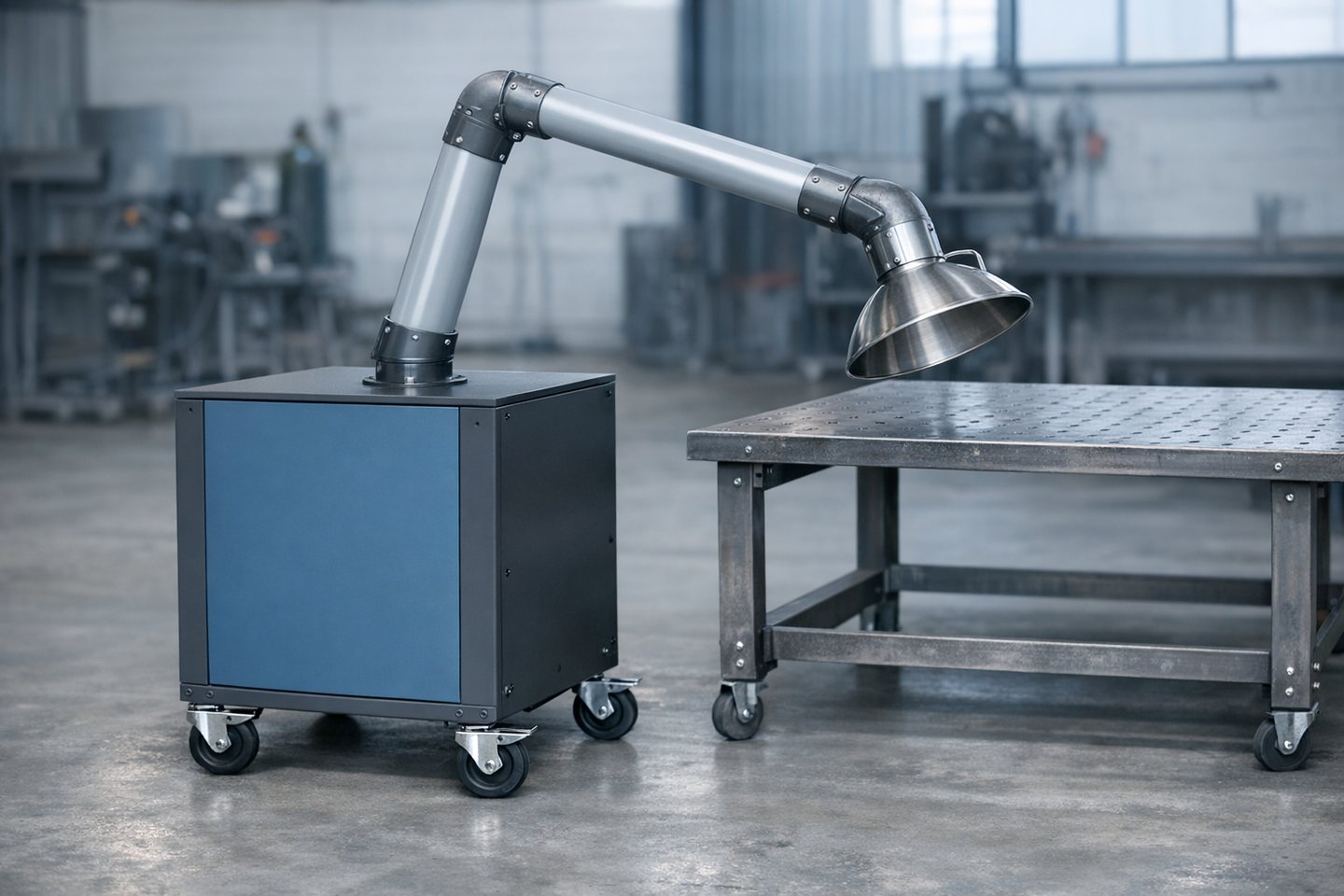
The FumeArm is a local exhaust unit for welding. A self-supporting arm, 3 m or 4 m long, holds a 160 mm capture hood where the welder puts it, and a fan draws about 1 100 m³/h of air through the hood. The fume goes through a spark pre-separator first and then into pleated filter cartridges, and clean air comes back out the cabinet. Nothing needs ducting through the roof on the mobile version, so it moves from bay to bay on its castors.
It is meant for the work most of our customers do every day: MIG and flux-core on mild steel frames and trailers, stick welding in maintenance shops, and TIG on stainless for catering and food plant. Wall-mounted arms suit fixed bays where the same welder works all shift. The mobile unit suits yards where the job is too big to move and the welder goes to the job instead.
Why fume at the arc matters more than a big roof fan
Welding fume is a mix of very fine metal oxide particles and gases. The International Agency for Research on Cancer classed welding fume as a cause of cancer in people in 2017, and the metals in the wire and base metal add their own problems: manganese from mild steel wire, hexavalent chromium and nickel when you weld stainless, and zinc oxide off galvanised gate and railing work, which gives welders the shivers and flu-like "metal fume fever" the same night.
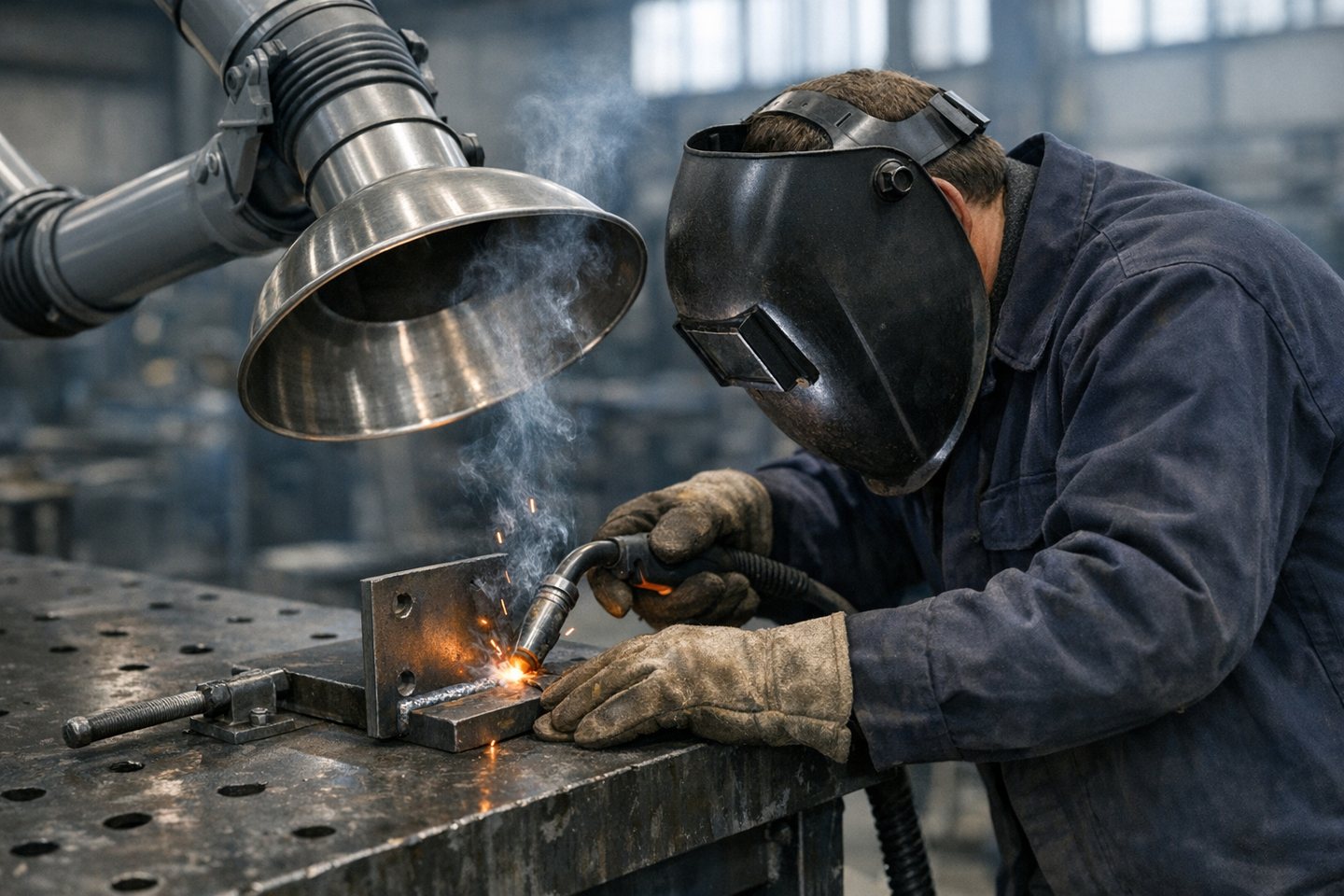
Roof extractors and open doors move a lot of air, but they move it past the welder's face on the way out. A capture hood only works close up. Airflow drops off fast with distance, so as a rule the hood must sit within about one to two hood diameters of the arc, roughly 200 to 300 mm, and slightly behind or to the side so the plume rises into it. Most bays we visit has the hood parked a metre away and that is the single biggest reason extraction "doesn't work".
The Regulations for Hazardous Chemical Agents, 2021 under the Occupational Health and Safety Act expect employers to control exposure at the source where they can, and local extraction is the control an occupational hygienist will look for first during an air monitoring survey. The FumeArm gives you that control without changing how your welders work.
Setting up a bay and pairing it with other gear
Mount the wall arm on a column or bay wall so the full reach covers the BenchMaster Pro top and the area where big parts sit on stands. On the mobile unit, park the cabinet behind the welder, not between the welder and the job, so the arm comes over the shoulder and the cable and hose don't cross the walkway.
Teach every welder to move the hood each time they move along the seam. It takes two seconds with the handle on the hood rim. Pair it with welding curtains from the TorchBay Station layout so the neighbouring bay stays clear, and keep respirators at the PPE Station Bay for jobs where the hood cannot get close, such as inside tanks or under trailer chassis.
- Wall arm for fixed bays, mobile unit for big jobs
- Hood within 200 to 300 mm of the arc
- Curtains between bays to stop drift
- Respirators for confined and awkward positions
The FumeArm is built for welding fume. Do not use it as a grinding extractor. Heavy grinding swarf and sparks overload the pre-separator quickly, so grinding belongs on the GrindDeck Safe with its own spark containment and dust drop.
Filters, cleaning and what to check each week
The cartridges are pulse-cleaned with compressed air at 5 to 6 bar. On the standard units this happens automatically when the fan stops at the end of a shift, and the dust drops into a closed bin at the bottom of the cabinet. A pressure gauge on the front shows how loaded the filters are. When it stays high straight after a cleaning cycle, the cartridges are due for replacement.
For stainless and high-alloy work we fit cartridges tested to the W3 welding fume class. Mild steel bays can run the standard cartridges. Empty the dust bin with gloves and a disposable P2 mask, and bag the dust, don't shake it out in the yard.
- Empty the spark tray and dust bin weekly
- Look for burn holes in the arm hose and hood gasket
- Check the arm joints still hold the hood where you leave it
- Note the gauge reading on the shift card
After a power cut the fan stays off until someone restarts it, and a hood with no fan is just a lid. Make it a rule that nobody strikes an arc until the extractor is running again. If you run welders off a generator during long power cuts, the mobile unit draws about 1.1 kW running, so allow for the start current when you size the genset.
How to check what your floor needs
Count your welding bays and note which ones work on the same bench every day and which ones follow the job. Look at the materials: a yard that welds mostly mild steel needs a different filter plan to a shop that does stainless catering frames three days a week. Measure from where an arm could mount to the far corner of each bench, that tells you whether 3 m or 4 m is right.
For four or more fixed bays side by side, a central ducted system with one fan often costs less to run than four separate units, and we will say so. Send us a message through our contact form with a rough bay sketch, the processes you run and photos of the current setup, and we come back with a practical layout and quote.
- Number of fixed and moving bays
- Processes and base metals welded
- Reach needed from the mounting point
- Power available at each bay, 230 V or 400 V
Why yards choose the FumeArm Extractor
Fume taken at the arc never reaches the welder's breathing zone or the next bay. The FumeArm puts the hood where the work is and keeps it there.
- Self-supporting arm
- Pulse-cleaned filters
- Mobile or wall mount
| Airflow | About 1 100 m³/h at the hood |
|---|---|
| Arm | 3 m or 4 m, self-supporting, 360° swivel |
| Hood | 160 mm with handle and damper |
| Filtration | Spark pre-separator, pulse-cleaned cartridges, W3 option for stainless |
| Power | 230 V mobile, 400 V three-phase wall units |
| Use | MIG / TIG / stick / flux-core |